AI proposes. You approve. Nothing described below writes to your governed model without a person previewing and accepting it first. Missing information stays a visible, named gap — it is never quietly invented into false precision.
From a sentence to a governed model change
Most "AI for architecture" demos show a prompt going in and a diagram coming out, as if the hard part were generating plausible-looking boxes and arrows. The actual hard part is everything around that step: checking the proposal against a real model, making obviously missing information visible instead of silently filled in, and keeping a human in charge of what actually becomes architecture. That's the part CelinQ is built around.
A worked example
Say the existing shared architecture already has a Customer Portal, an
Identity Service, and a CRM. A stakeholder email arrives:
"Customers must be able to authenticate using the corporate identity provider before
accessing the portal." Reasoned in isolation, an AI can only restate that sentence back as
a diagram. Reasoned against the architecture that already exists, it can propose something
more specific: extend the existing Identity Service rather than invent a new
one, add a new integration to an external identity provider, and flag Customer
Portal and the relevant authentication interface as impacted.
What makes this trustworthy rather than merely impressive is what it does not do: it does not decide, on your behalf, which identity provider is authoritative if that was never stated. It surfaces that as an open decision rather than guessing at one plausible answer and presenting it with false confidence. What a deterministic pass over a model can tell you without AI, and what a grounded AI summary adds →
What this actually does today
Describe it, see it drafted
From EA's own menu — Generate into Selected Package — a plain-language
description becomes real elements and relationships, drafted into the package you
selected and previewed before anything is applied.
Ask about what's already there
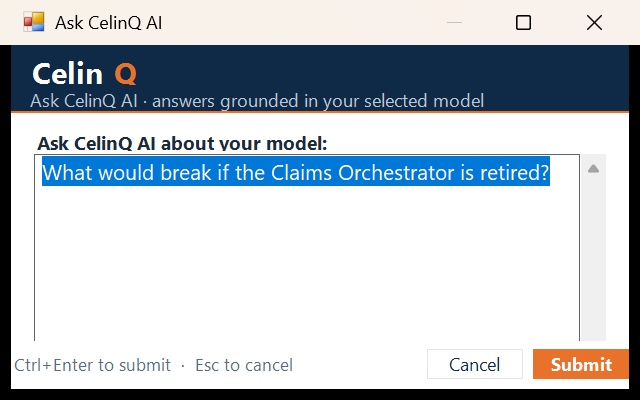
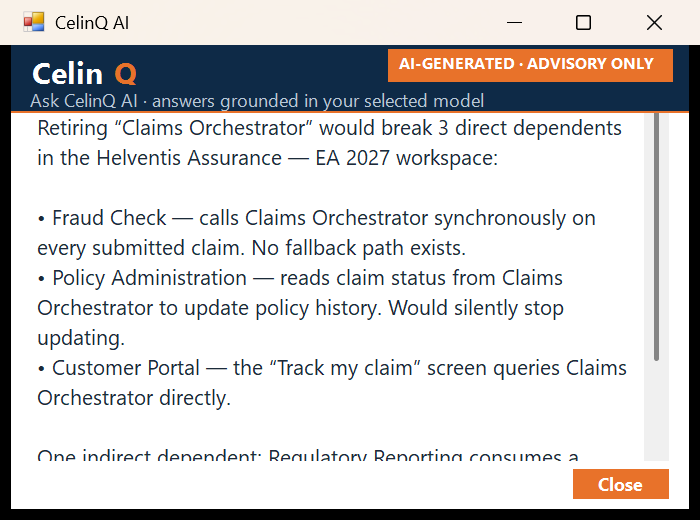
Analyze Selected Package and Ask CelinQ AI give a grounded
reading of the part of the model you selected — answers name the actual elements
involved, not a generic summary. Reading
an unfamiliar landscape quickly and honestly →
Back to the requirement that caused it
A proposed change traces back to the input that prompted it — not a black-box suggestion with no paper trail. Traceability that holds when contributors come and go →
A human decides, every time
Every proposal is previewed, editable, and rejectable. Nothing reaches the shared, synchronised model without approval — an AI recommendation sits beside a human decision, never replaces it →
Optional, on every server
An administrator switches AI on feature by feature. Sovereign mode removes it entirely and irreversibly. Sovereign and customer-hosted deployment patterns →
Approved changes reach everyone
Once approved, a change synchronises through the same Fusion merge engine as any other edit — reconciled against concurrent work, never silently overwriting it.
What this deliberately doesn't do
It does not invent requirements that were never in the source text. It does not auto-apply a proposal without a human in the loop. It does not claim perfect judgement — genuine architectural trade-offs (which identity provider, which integration pattern) stay exactly where they belong: with the architect. Shared architecture gives this more to reason against → — the same requirement checked against several projects' worth of existing elements, not just the one file open right now.
See it against your own architecture
This exact Customer Portal / Identity Service exchange is captured live in the demo below — then a trial workspace is seeded with the same scenario, ready to reproduce against a real repository.